
Car Care & Detailing · Paint Protection Review
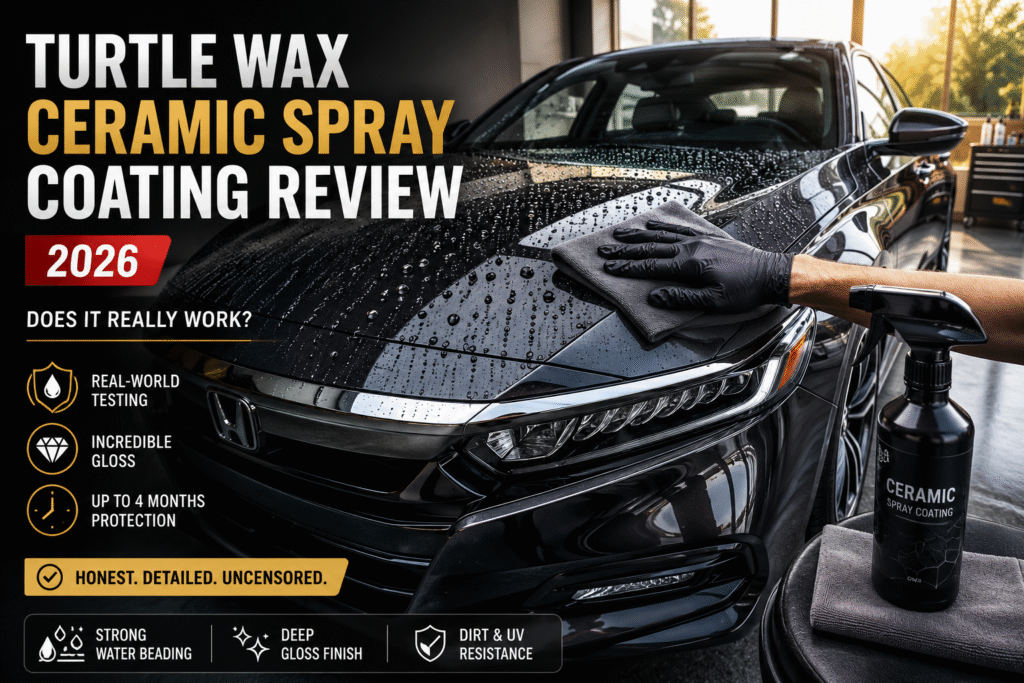
Turtle Wax Ceramic Spray Coating Review (2026): Does It Really Work?
Six months of real-world testing on a daily driver — here’s the honest verdict.
The Turtle Wax Hybrid Solutions Ceramic Spray has become one of the most-discussed consumer ceramic sprays on the market — mostly because of the price. Under $20, spray-and-wipe application, and claims of up to 12 months of protection. Sounds almost too good. After testing it over six months on a daily-driven 2019 Honda Accord in mixedF city and highway use, here’s what I actually found.
This review is for daily drivers, weekend detailers, and anyone curious whether this product is a genuine upgrade over traditional wax — or just clever marketing.
Quick Verdict
Bottom Line
Yes — with realistic expectations
At $17, Turtle Wax Ceramic Spray delivers real water beading, visible gloss improvement, and better dirt resistance than carnauba wax. Durability won’t hit 12 months in real-world conditions, but for the price, it punches well above its weight.
Best for
- Daily driver owners
- Detailing beginners
- Budget-conscious buyers
Not ideal for
- Multi-year protection seekers
- Show-car / corrected paint
- Replacing pro-grade coatings
The Product

It’s a consumer-grade SiO2 (silicon dioxide) spray coating — the same compound used in professional ceramic coatings, in a lower concentration and a much friendlier carrier formula. Turtle Wax formulated it so the product wipes off easily without streaking, which was a common frustration with earlier ceramic sprays from various brands. Compatible with paint, glass, plastic trim, and wheels. Not recommended for matte or satin finishes.
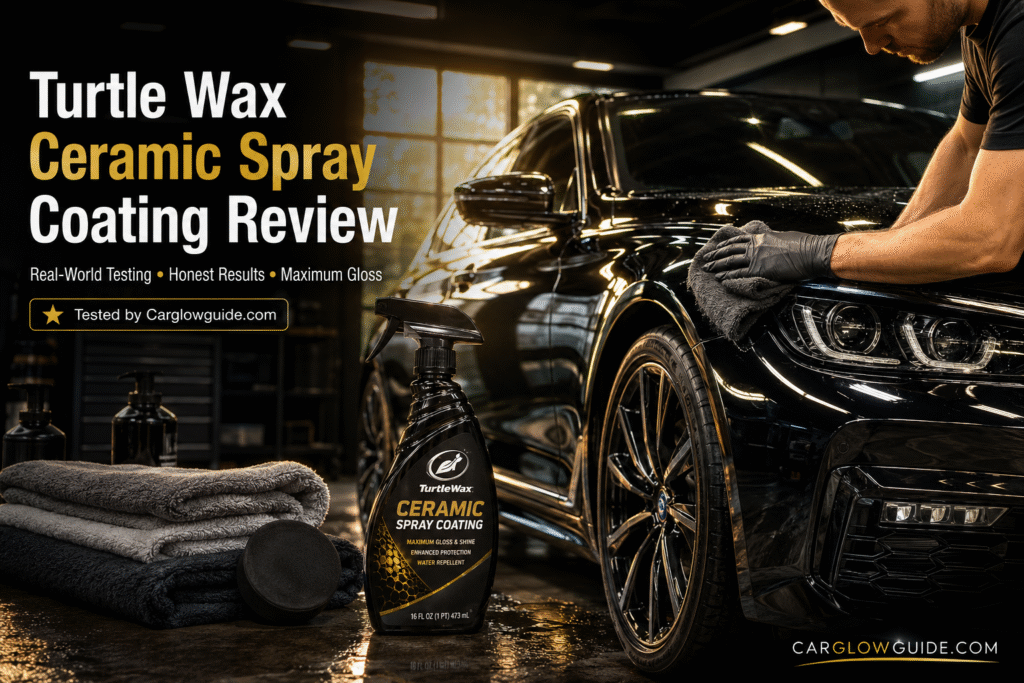
How I Tested It
Vehicle: 2019 Honda Accord, Sonic Gray Pearl. Surface prep: two-bucket pH-neutral wash, full clay bar treatment, no paint correction. Conditions: mixed city and highway driving, regular rain exposure, weekly washes (hand wash and occasional touchless), and sun exposure through spring. I retested water beading and gloss at the one-, three-, and six-month marks.
How to apply Turtle Wax Ceramic coating Spray
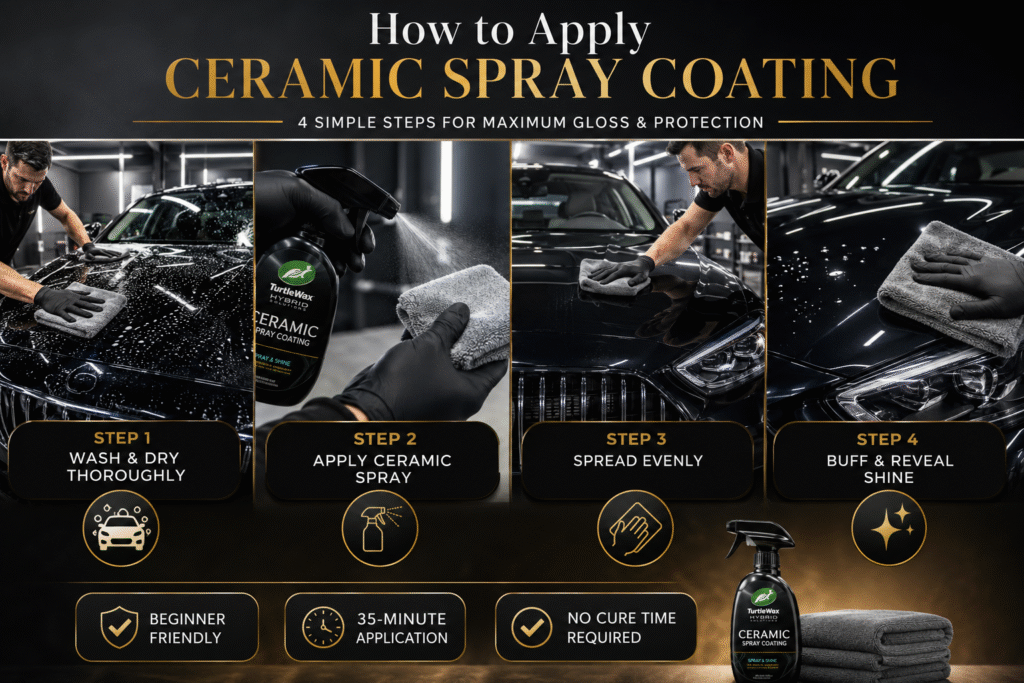
- Wash and dry completely. Surface must be clean and bone dry — any dirt or water spots get sealed in.
- Work in shade, panel by panel. Direct sun causes the product to flash too fast, leading to high spots and difficult removal.
- Spray 3–4 pumps onto the panel or onto a folded microfiber. Don’t overapply — this is the most common mistake users make.
- Spread with light circular passes, then finish with straight-line buffing to even coverage.
- Buff off immediately with a clean, dry microfiber. No haze time, no curing. It wipes clean almost instantly.
Total time on the Accord: about 35 minutes. No streaks, no high spots, no leftover product. Ease of application: 9/10. It genuinely is as simple as the label implies.
Real-World Performance
Gloss and first impressions
Immediately after application, the paint had a visibly deeper, wetter look. On the Sonic Gray, the metallic flake clarity improved noticeably. On a friend’s black Camry where I used the same product, the result was dramatic enough that he thought I’d polished the car. I hadn’t. That’s the SiO2 layer doing its job.
Water beading
The first rain came three days post-application. Tight, high-contact-angle beads formed across every panel. At highway speed, droplets shook off cleanly with no trailing water. Sheeting and beading were both active in the first two weeks. Dirt between washes rinsed off significantly easier — the surface was releasing grime rather than holding it.
Durability over time
Month 1: Water beading was strong across all panels. Gloss retained well. No degradation worth noting.
Month 3: Beads were flatter and less aggressive. Sheeting was largely gone. High-contact areas (hood leading edge, door handles) showed earlier wear. Still better than bare paint, but clearly declining.
Month 6: Water beading had dropped to roughly the level of a fresh carnauba wax application. The surface was still smoother than untreated paint, but the ceramic performance was largely spent. Reapplication at or before three months resets everything.
Pros and Cons
Pros
- Excellent value at $17
- Truly beginner-friendly application
- Strong water beading fresh after use
- Visible gloss boost, especially on dark paint
- Works on glass, wheels, and trim
- No curing time needed
Cons
- Real durability is 3–4 months, not 12
- Needs proper prep to perform well
- Overapplication causes streaking
- UV protection is modest only
- Not a substitute for pro coatings
How It Compares: 4-Product Comparison
| Feature | Turtle Wax Ceramic | Meguiar’s Hybrid Ceramic | Griot’s Garage 3-in-1 | Ethos Ceramic Speed Wax |
|---|---|---|---|---|
| Price | $17.19 Best Value | $19.97 | $16.99 | $24.50 |
| Durability | 3–4 months | 4–5 months | 2–3 months | 4–6 months Best |
| Water Beading | Excellent | Very Good | Good | Excellent |
| Gloss | Very Good | Very Good | Good | Excellent Best |
| Ease of Use | Excellent Easiest | Excellent | Very Good | Good |
| Value for Money | Excellent Best | Good | Good | Fair |
| Best For | Budget / beginners | Balanced performance | Quick detailer combo | Enthusiasts |
Head-to-Head Comparisons
Turtle Wax Ceramic Spray Coating vs Meguiar’s Hybrid Ceramic Wax ($19.97)

The closest competitor. Meguiar’s holds water beading slightly longer — closer to 4.5 months vs Turtle Wax’s 3. The gloss from Meguiar’s has a slightly warmer, deeper quality that I prefer aesthetically, but it’s a close call. For a $2.78 difference with nearly identical application ease, Turtle Wax wins on pure value. If you want to stretch reapplication intervals by a few weeks, Meguiar’s is worth the small premium.
Turtle Wax Ceramic Spray Coating vs Griot’s Garage Ceramic 3-in-1 Wax ($16.99)

The “3-in-1” positioning means it’s a different product solving a different problem. As a quick detailer that adds some ceramic protection, it’s useful. As a dedicated coating, it underdelivers — water beading started fading noticeably around weeks 6–8 in my testing. For standalone ceramic protection, Turtle Wax is the better choice. Griot’s earns its place as a maintenance product between full applications.
Turtle Wax Ceramic Spray Coating vs Ethos Ceramic Speed Wax ($24.50)

The one product in this group that genuinely outperforms Turtle Wax on durability and gloss depth. Higher SiO2 concentration shows up in real testing — water beading at five months from Ethos matched what Turtle Wax delivers at one month. The gloss on dark paint is noticeably better. At $7 more per bottle and longer application intervals, the total annual cost difference is smaller than it looks. If you’re an enthusiast who wants the best consumer-grade spray without quarterly reapplication, Ethos is worth it. For everyone else, Turtle Wax is the smarter buy.
Frequently Asked Questions
Does Turtle Wax Ceramic Spray really work?
Yes. It produces genuine water beading, visible gloss improvement, and better dirt release between washes. It won’t replicate a professional ceramic coating, but it consistently outperforms traditional carnauba wax — and for $17, that’s a real win.
How long does it actually last?
On a daily-driven, regularly washed vehicle: 3–4 months of strong performance. The “up to 12 months” claim is for ideal conditions. Plan for a quarterly reapplication to keep water beading and gloss at their best.
Can it be applied to glass?
Yes, and it works well. It creates a hydrophobic layer that causes rain to sheet off at speed. Apply the same way as paint — spray, spread, buff off. Avoid interior glass. Reapplication may be needed more often due to wiper contact.
Is it safe on black cars?
Yes, and the gloss improvement on black paint is particularly impressive. Make sure the paint is clean and clay-barred first — any swirl marks or contamination are more visible under the coating layer on dark colors. Don’t overapply.
How often should it be reapplied?
Every 2–3 months for peak performance on a daily driver. Watch water beading behavior as your guide — when beads go flat or sluggish, it’s time to reapply. You can top up with a waterless wash between applications to extend the intervals slightly.
Final Verdict
The Turtle Wax Ceramic Spray delivers exactly what a $17 ceramic spray should: genuine water beading, improved gloss, easy application, and protection that outlasts traditional wax. Its limitations are honest ones — durability doesn’t match the label claim, and it’s not going to compete with professional coatings. None of that should surprise anyone.
For daily drivers who want a meaningful step up from paste wax without spending serious money, this is a straightforward recommendation. Apply it quarterly, prep your paint properly, and it will do its job consistently.
Disclosure: This article contains affiliate links. We may earn a small commission if you purchase through one of those links at no extra cost to you. All opinions are based on independent testing.
